
Plainfield Directory Collections by Era
The Plainfield Area Public Library local-history collection is the main catalog for the historical directory shelf. Its holdings do not form one unbroken annual run. They include local phone books from roughly the mid-1920s through the mid-1950s, Plainfield and Lockport directories from 1973 through 1993, and regional Joliet volumes that may contain Plainfield entries. The Newberry’s inventory adds a Plainfield holding for 1927 and 1928. Each title must be checked page by page because regional coverage does not guarantee that every Plainfield household appears.
| Collection | Years | Where Held | Access |
|---|---|---|---|
| Plainfield local phone books | About 1924/1925-1955/1956 | Plainfield Area Public Library | Library collection; confirm each volume |
| Plainfield/Lockport directories | 1973-1993 | Plainfield Area Public Library | Onsite collection |
| Regional Joliet directories | 1900, 1927, 1932, 1966-present | PAPL and regional holdings | Check for Plainfield entries by edition |
| Plainfield city directory holding | 1927-1928 | Newberry directory inventory | Cataloged holding; verify access |
| Polk's Joliet/Will County directory | 1938 | Regional catalog holdings | R. L. Polk & Co.; full local page not captured |
The listed ranges overlap but are not interchangeable. PAPL describes two slightly different phone-book spans, so the specific volume should be confirmed before a visit. No stable public scan of a Plainfield reverse or criss-cross entry was located, and the public guides do not identify publishers for every local run. Those are real gaps. Ask library staff what is onsite, what requires a library card, and whether an abbreviation page can be copied with the entry.
Regional titles need one more check. A Joliet or Will County volume may list a Plainfield name under a township, a business heading, or an outlying place section rather than in the main alphabetical run. Search the surname index, scan the street pages when they exist, and check the table of contents before deciding the person is absent. For phone books, note whether the number belongs to a home, firm, or shared line. Keep the exact title on every citation. Similar cover dates can hide different geographic scope, and a later catalog description may combine volumes that were issued as separate books.
Plainfield Directory Research at PAPL
The Plainfield Area Public Library, 15025 S Illinois Street, is the practical first stop. Its posted hours are Monday through Thursday, 9:00 a.m. to 9:00 p.m.; Friday and Saturday, 9:00 a.m. to 5:00 p.m.; and seasonal Sunday hours, 1:00 to 5:00 p.m. Call 815-436-6639 before traveling to confirm a volume, reader, or database. The genealogy resources guide connects directory volumes with census film, newspapers, vital material, cemetery ledgers, yearbooks, and subscription databases available onsite or with a card.
The library’s official archival-repository entry confirms directories, phonebooks, census, Village minutes, township records, fire-department material, Sanborn maps, and Enterprise microfilm. That mix is useful when a name vanishes between editions. A newspaper notice may explain a move or death, while a plat or map may explain why an old street label no longer matches the current one.
The source view of the Plainfield genealogy collection shows how the library organizes these routes:
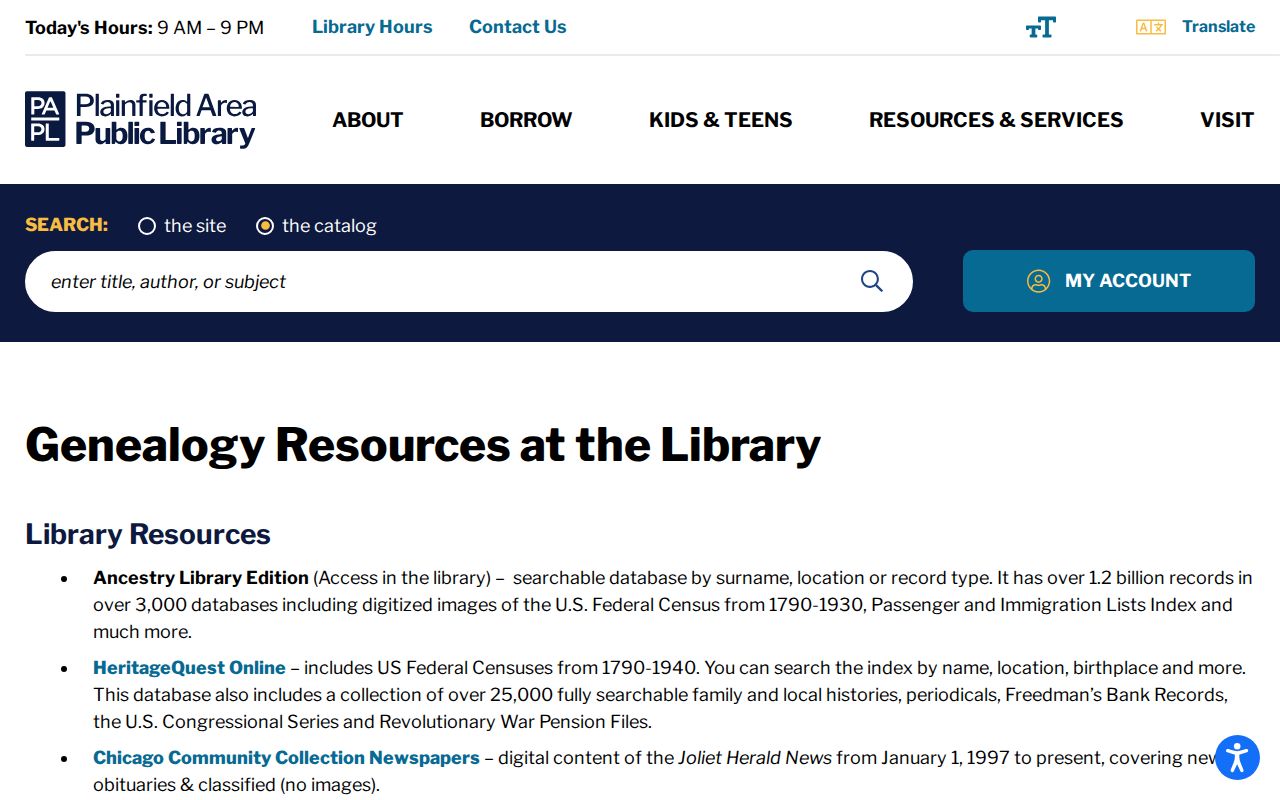
Use that guide to plan the search, then confirm the exact title and year with staff. Database access rules can differ between home and the library building.
Plainfield Directories Meet Digital Archives
A printed directory supplies a dated name and street link. Plainfield’s digital collections help test that link. The digitized Plainfield Enterprise covers a long newspaper run, though PAPL describes the searchable index as roughly 1957-2019 in one place and 1928-2019 in another. Enterprise microfilm begins in 1893 and has gaps. Search both the name and the address, then save the publication date and page reference.
Will County Preserving History’s Heritage adds grantor and grantee indexes from 1835-1885, atlases, cemetery records, obituaries, and source images. It does not replace the city directory shelf. Instead, it can connect a household name to a deed page, burial record, or map. The collection grew from a 2009 Illinois State Library digitization grant involving the library, historical partners, and the Will County Recorder.
Reading Plainfield City Directory Entries
Read the title page and abbreviation key before reading an entry. The only publisher confirmed in the research is R. L. Polk & Co. for the 1938 Joliet and Will County volume. No official Plainfield page image was captured, so a generic symbol should never be assigned to a local entry. Record only the fields that the chosen edition actually prints.
| Name | Copy the printed form, initials, and spelling exactly. |
|---|---|
| Street or address | Record the full printed line and publication year. |
| Telephone or business context | Appears in some runs; it is edition-specific. |
| Spouse, widow, or role mark | Use only when the edition’s key defines it. |
| Occupancy symbol | Do not assume ownership; check the key and deed separately. |
- Criss-cross directory
- A directory arranged by street or address rather than only by surname.
- Householder index
- A list centered on the named person associated with a household in that edition.
- Abbreviation key
- The publisher’s guide to shortened words and symbols. Copy it with the entry.
A directory name can identify an occupant, subscriber, business contact, or household head. It does not automatically prove title to land. For modern parcel evidence, use the Plainfield street directory workflow and the correct county record.
Plainfield Yearbooks and Newspapers
Yearbooks and newspapers can separate people who share a name. PAPL lists Plainsman yearbooks for 1949-2000, Plainfield High School material described through 2010, and K-8 volumes from 1972-1995. Availability varies. A yearbook can place a name in a school year or activity, but it should not be used to infer a current address.
The Enterprise collection is broader. Its index fields can include a name, place of death, publication date, volume or section, and notes. PAPL warns that an item may be a death notice, funeral notice, probate notice, claim notice, or thank-you notice rather than a full obituary. Label the item type. Then compare it with cemetery, probate, or directory evidence instead of treating the index line as the whole story.
Plainfield Directory Shelf Timeline
The publication shelf makes more sense beside the town’s record history. Early census, land, and township sources fill years before local directories became common. Later phonebooks and regional editions bridge the gap to modern records.
| 1835-1885 | Will County grantor/grantee indexes now available through WCPHH. |
|---|---|
| 1924-1956 | Approximate span of the overlapping local phone-book runs. |
| 1927-1928 | Plainfield holding identified in the Newberry directory list. |
| 1938 | R. L. Polk & Co. regional Joliet/Will County directory. |
| 1973-1993 | Plainfield/Lockport directory run held by PAPL. |
| 2009 | State grant supported digitization of Will County historical records. |
No source found the first or last Plainfield-specific printed edition. The timeline therefore describes known holdings, not a claim that nothing was published outside those dates.
Plainfield Records After the Tornado
PAPL’s 1990 tornado interview collection preserves first-person accounts and photographs from the August 28 disaster. It is a place-based companion to a directory search. A dated interview or image may explain why a street, school, or household appears differently in later records, but private details should stay within the historical purpose for which the collection was made.
The collection’s source page is visible in this captured reference:
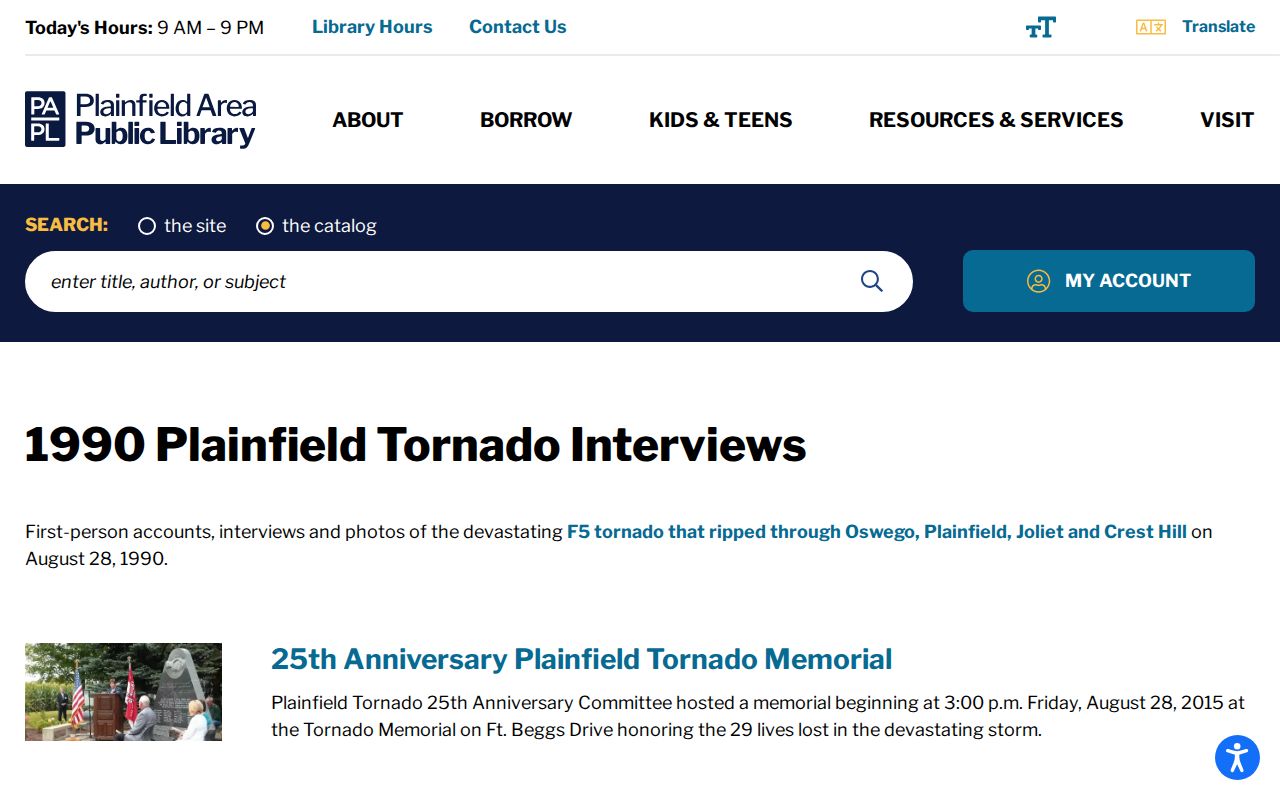
Pair any place named there with a dated directory, map, or newspaper page. Current GIS should be used only to locate the modern parcel, not to rewrite the historical account.
Plainfield Directory Years in Context
The library’s Village history traces settlement from Walkers Grove in 1828 through establishment in 1834, separate incorporations, and the 1877 consolidation. That timeline helps explain why an early person may be indexed by township, county, settlement name, or map rather than under modern Plainfield.
The historical source appears here as captured for the project:
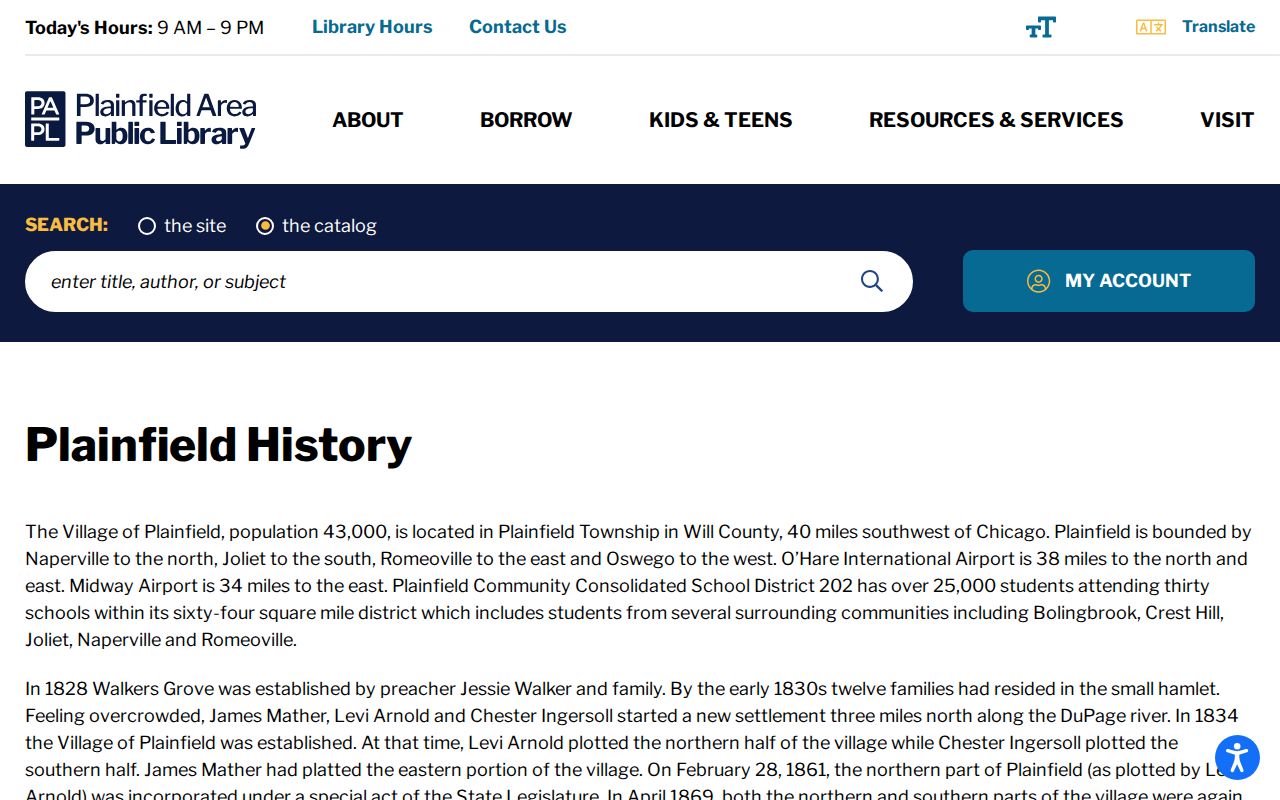
For addresses near the county line, preserve both Will and Kendall context. A postal label alone does not tell which courthouse or archive holds the underlying record.
Trace Families Through Plainfield Directories
Use each directory edition as a dated snapshot. Federal census film at PAPL includes 1820 and 1840-1930, subject to the normal public-image rule and changing boundaries. A directory can fill years between those census points. Atlases from 1873, 1893, and 1909 can add the older road, farm, or lot context that a name search misses.
- Start with the directory year nearest a known event. Copy the title, year, page, name form, and address.
- Check the next available edition. Track spelling, initials, street changes, and gaps without assuming why someone disappears.
- Compare the address with the nearest census, atlas, phone book, or newspaper year. Keep county and township labels intact.
- Use an obituary or cemetery ledger for a dated endpoint. Plainfield Township ledgers span 1837-2010, while card coverage ends earlier.
- Confirm property claims through the Recorder or assessor. A directory association is not a deed.
A missing entry can mean a move, death, changed name, changed street, skipped volume, or simple omission. Test each possibility with another dated source. Illinois Archives Global Search and its reference form provide a statewide fallback, and the form accepts only two names or items per mailing. Keep requests narrow and include the known date and place.
Older Plainfield research may also shift between township and Village labels. Cemetery cards, church records, probate film, and county atlases can preserve a name that never reached a printed directory. When two sources disagree, cite both dates and keep the difference visible. The later spelling should not silently replace the earlier one.